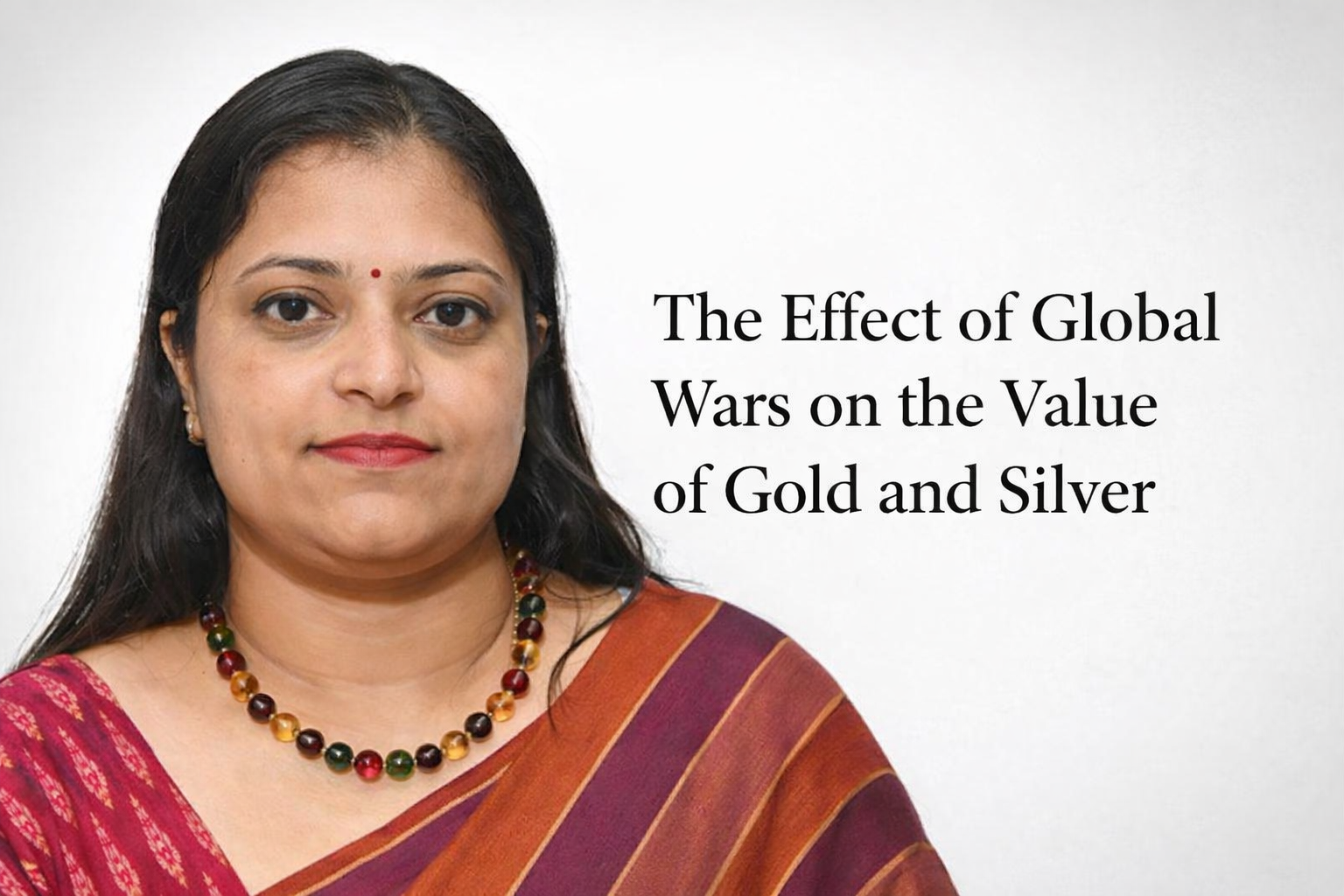

Dr LASYA K R
Assistant Professor
Christ University
Bangalore
Wars between countries often shake the global economy, and one of the areas where this impact is clearly seen is in the prices of gold and silver. For centuries, these precious metals have been considered reliable forms of wealth. Whenever the world faces uncertainty, people tend to move their money into assets that they believe will remain stable. Because of this long-standing trust, the prices of gold and silver usually rise during times of war or international conflict.
One of the main reasons for this increase is the uncertainty that wars create. When two or more countries are involved in conflict, trade routes may be disrupted, businesses may slow down, and economies can become unstable. Investors often worry that stocks, currencies, and other financial assets may lose value in such situations. To protect their wealth, they turn to gold and silver, which are known for holding their value even during difficult times. As more people begin buying these metals, their demand rises, which naturally pushes their prices higher.
Another important factor is government spending during wars. Military conflicts require enormous financial resources. Governments must spend large amounts of money on defense equipment, weapons, transportation, and other military operations. To cover these expenses, countries sometimes borrow heavily or print more money. When too much money enters the economy, inflation can occur, meaning the value of money decreases. In such circumstances, people often buy gold and silver because these metals tend to retain their value better than paper currency during inflation.
Wars can also affect the stability of national currencies. If a country involved in war experiences economic damage or faces international sanctions, its currency may weaken. A weaker currency reduces confidence among investors and the general public. As a result, many people look for safer alternatives to store their wealth. Gold and silver become attractive choices because they are globally accepted and not tied to the economic condition of a single country.
In addition, wars can interrupt the supply of precious metals. Mining activities may slow down if conflict occurs near mining regions, or transportation routes may become unsafe. Even if the war takes place far from mining areas, global trade disruptions can still affect how metals are transported and sold. When supply becomes limited while demand is rising, prices tend to increase even more.
Historical events provide many examples of this trend. During major global conflicts in the past, the value of gold often increased as investors searched for security. Silver also tends to rise during uncertain periods, although its price can sometimes fluctuate more because it is widely used in industries such as electronics, solar panels, and manufacturing.
At the same time, it is important to remember that these price increases may not always last forever. Once a conflict begins to settle and economic stability returns, investors may shift their focus back to stock markets and other investments. When this happens, the demand for safe-haven assets like gold and silver may decline, causing their prices to stabilize.
Overall, wars between nations influence gold and silver prices mainly because they create uncertainty, inflation, currency instability, and supply disruptions. In times of crisis, people naturally seek financial security, and precious metals have long been viewed as a dependable way to preserve wealth. Because of this, the demand for gold and silver usually rises whenever the world faces geopolitical tensions.
Author
Dr LASYA K R
Assistant Professor
Christ University, Bangalore.