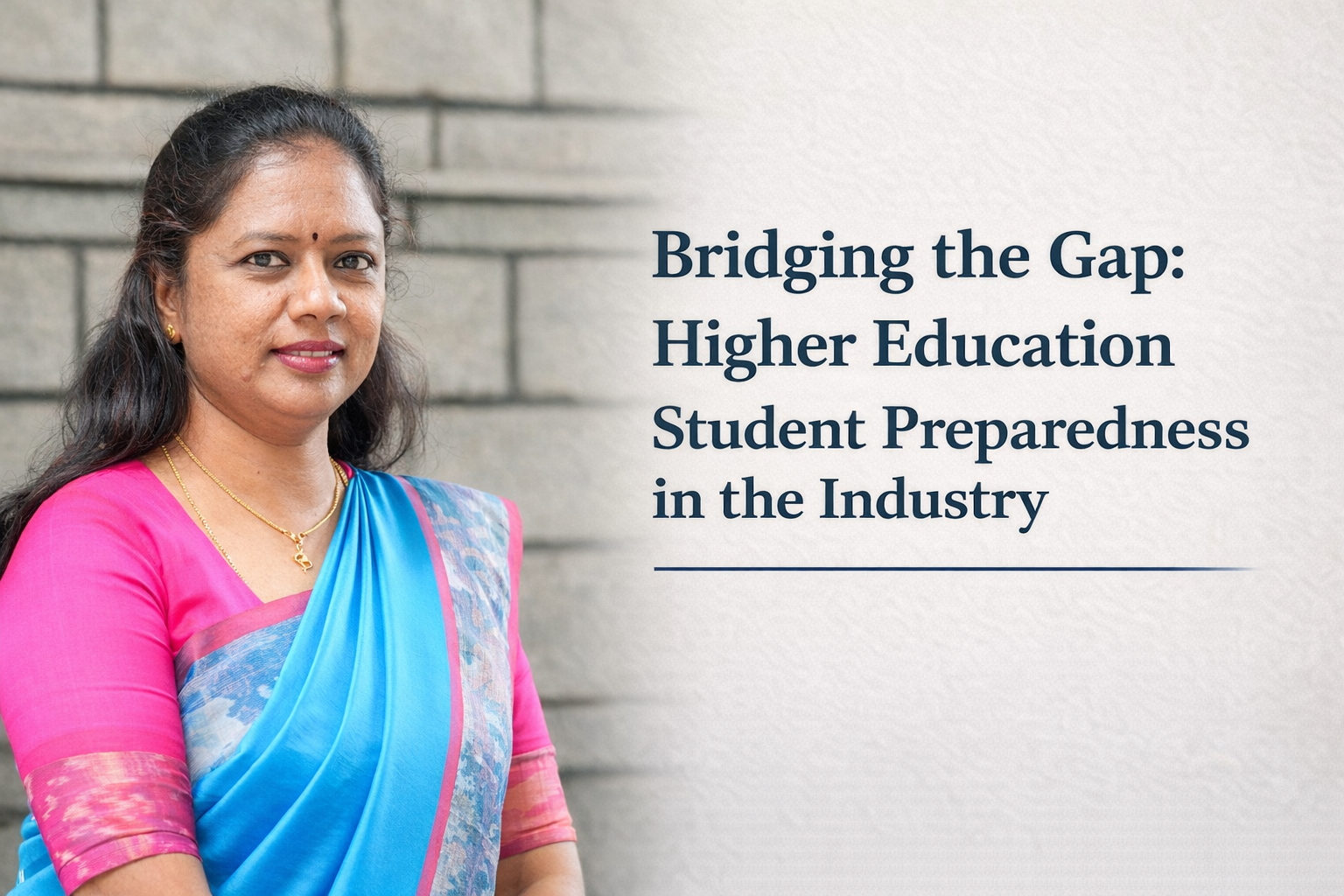

Dr Usha N
Assistant Professor
Christ University
Bangalore
The increased growth of higher education in India has been observed over the past 20 years when universities and colleges have sprung up in every state. However, one of the recurrent issues that are being raised by employers is the fact that a considerable part of graduates are not ready to meet industry needs. Although educational experience provides students with a theoretical background, working environment demands a combination of technical skills, problem-solving skills and other interpersonal skills, which students seldom develop in classrooms.
At the recent surveys of employability, only under half of the Indian graduates are thought to be easily employable. The mismatch is brought about by the fact that the curricula in most institutions respond slowly to changes in the industry. As an example, the programs in engineering can continue to provide intensive training in out-of-date coding languages when the information technology field requires acquiring skills in artificial intelligence, cloud computing, and data analytics. Equally, management students do not have the practical access to live projects or internships, which can provide a replica of the real business issues.
This worsening disparity does not only frustrate employers but also leaves graduates at bay in a competitive job market.
Industry preparedness has ceased to be a good-to-have, but a requirement. Employers now seek candidates that can make contributions immediately. This requires:
- Industry standards of technical capabilities
- Soft skills like communication, team, adaptability and critical thinking
- Hands on experience by internships, live projects, and industry-academia projects
- Global mindset, since numerous industries are presently acting in the international markets
Being prepared means that students will not be prepared as degree-holders. Recruiters have been complaining that despite the good performance of students in written tests, they fail in interviews and group discussions. One of the HR leaders of a large IT company in Bangalore comments “we have bright students with high marks but once they are exposed to practical application of the problem or communicating with clients, they hesitate”. This is where educational establishments must go in to play. Start-ups and SMEs are not any different. They are interested in graduates who will be able to wear various hats, operate with little supervision, and be fast-adaptive.
Colleges and universities play a critical role in dealing with this challenge. Few of the measures that can fill the gap are,
- Reviewing of curriculum with industry professionals.
- Compulsory internships or co-operative programs in degree programs.
- Workshops on resume writing, interview handling and corporate etiquette
- Industry professionals mentorship and guest lectures.
- Case study-based simulation learning with hackathons and business competitions.
By entrenching these practices, not only do institutions increase the outcomes of their students, but they also gain themselves a good reputation as talent incubators. Though it is important that institutions assume the lead, the students should also be proactive. It is no longer enough to rely only on lectures in the classroom. Online courses, professional certifications, internships, and network platforms can help greatly to increase industry preparedness. Employers are inclined to such qualities as self-learning, exposure to a variety of projects, and the development of a curious attitude. India is on the brink of a demographic dividend and the young population constitutes a significant percentage of the workforce. Nevertheless, the dividend will be only paid in case the students entering the labor force are ready to meet the requirements of Industry 4.0 and further. Academia and industry partnership does not just start by placing tokens and the university and the company; their relationship should transform into an ongoing discussion on skill development. With millions of graduates leaving campuses in Bangalore and universities across India every year, there is no doubt that higher education needs to be doing more than simply delivering knowledge, it must also be breeding industry-ready professionals capable of innovation, productivity, and growth.
Author
Dr. Usha N
Assistant Professor
Christ University, Bangalore