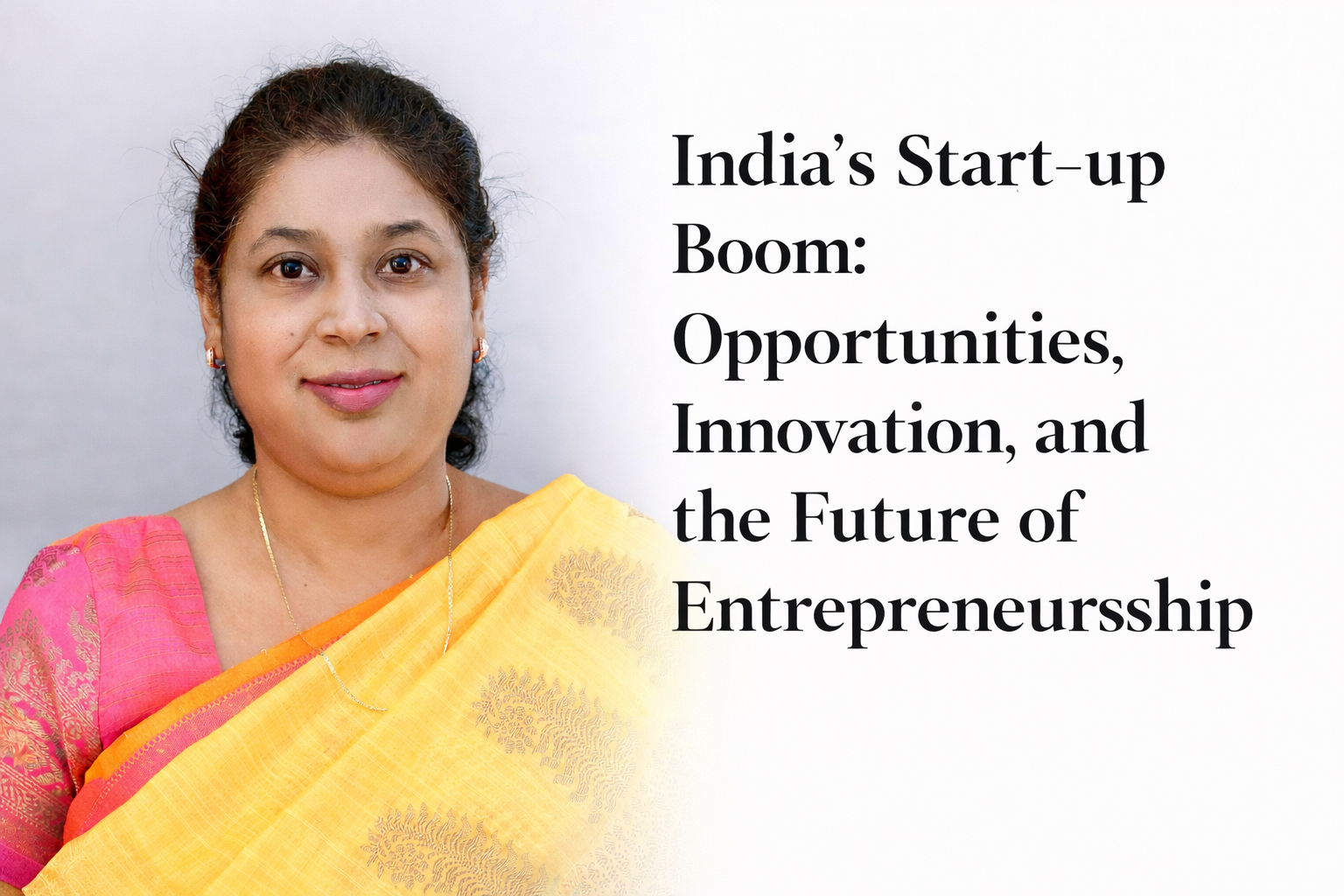

Dr. Oshma Rosette Pinto
Assistant Professor
Christ University
Bangalore
India is presently witnessing an outstanding transformation in its innovation ecosystem and has developed into one of the world’s most robust start-up environments over the last 10 years. India is ranked the third-largest start-up ecosystem in the world, hosting over 200,000 start-ups and 125 unicorns, up from 4 in 2014. As of January 2026, 51% of start-ups are from Tier-2 and Tier-3 cities, after the US and the UK, and have created around 21 lakh direct jobs. This showed a drastic change from a traditionally conservative economy to one driven by novelty, technical expertise, and entrepreneurship.
One of the major reasons for this development is the accessibility of funds and investor confidence. In 2025, start-ups in India raised around $10.5 to $11 billion in funding, indicating continued global interest in India’s entrepreneurial ecosystem. Venture capitalists and angel investors are rapidly investing in start-ups across sectors such as fintech, AI, E-Commerce, and Health in India.
Examples on such novelty includes the health technology start-up Temple, founded by Zomato’s founder Deepinder Goyal, that raised $54 million in funding and achieved a valuation of $190 million after its launch. The AI companies are generating language models and softwares designed for the Indian market by supporting applications in finance, healthcare, and education, and addressing challenges such as agricultural productivity, digital payments, and supply chain efficiency. This development shows that experienced entrepreneurs are expanding into new sectors, with rapid growth in deep technology and AI start-ups, which are now 37 percent and have reached $2.3 billion, as investors are interested in AI robotics and data analytics. These not only help produce new technological products but also contribute to Indian digitalization.
Among the government initiatives, Start-up India, have enhanced funding, tax benefits, mentorship, and simplified compliance processes for new businesses. At the same time, universities, incubators, and innovation hubs encourage students and young professionals to explore entrepreneurship as a career option. The start-up ecosystem has provided employment opportunities and contributed to the development of the economy, examples including Zomato’s, Flipkart, Ola, and Dream11. Many companies have achieved unicorn status, which demonstrates the excellent competitiveness of start-ups in India.
Despite the progress, challenges persist such as gaps in funding for early-stage start-ups, compliance difficulties, and restricted funding in women-led start-ups. Hence there is a need for more inclusive funding opportunities.
In conclusion, India’s start-up ecosystem is driven by novelty, technology, and supportive schemes that is shaping industries and generating opportunities for entrepreneurs. The investment in developing technologies such as AI and deep tech continues to develop; India’s start-up ecosystem plays a vital role in shaping the future of entrepreneurship and the development of the economy.
Dr. Oshma Rosette Pinto
Assistant Professor
School of Business and Management
Christ University
Bangalore