Dr Monica S
Assistant Professor
Christ University
Bangalore
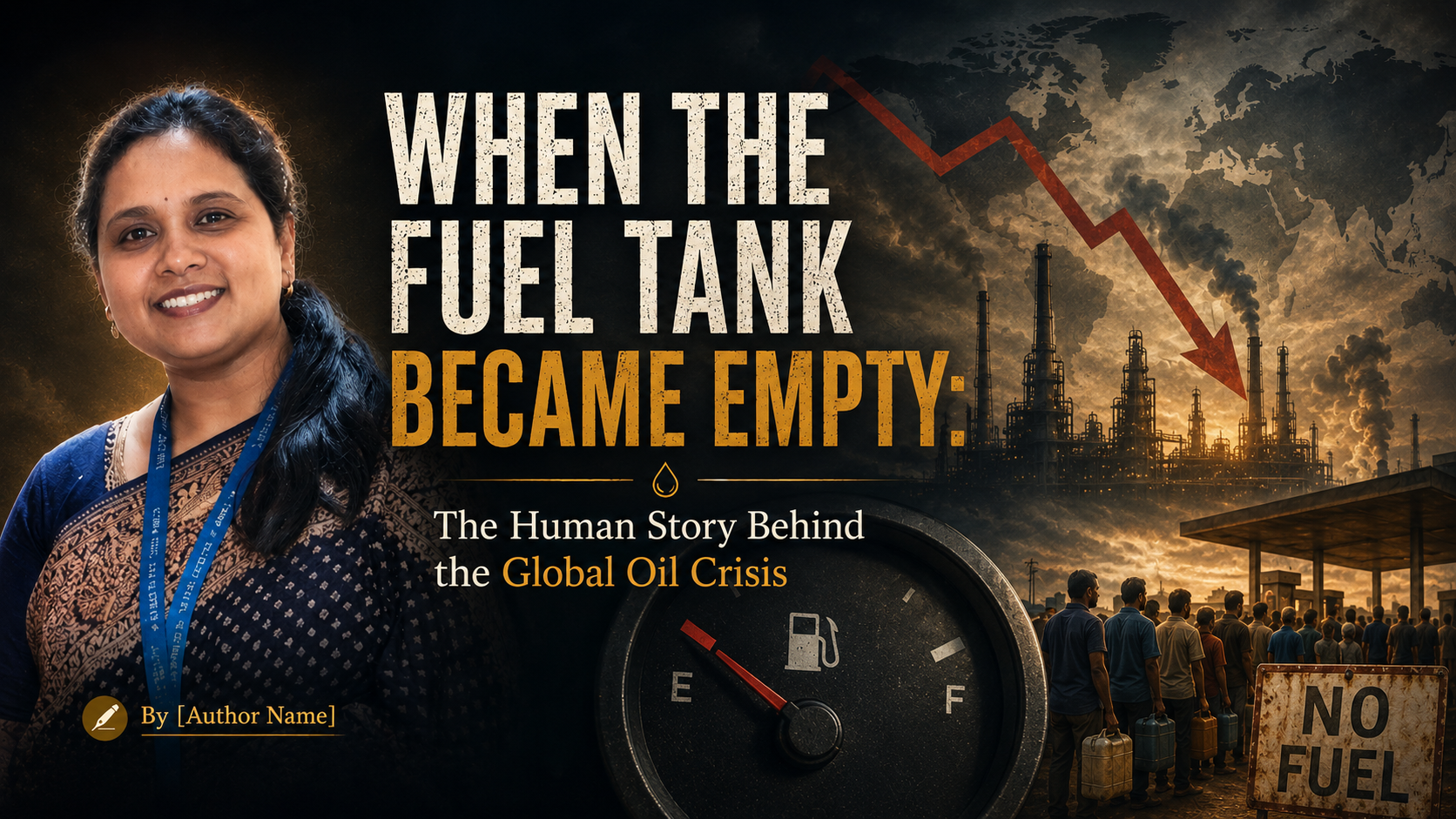
When the Fuel Tank Became Empty: The Human Story Behind the Global Oil Crisis
The morning traffic in Bengaluru moved slowly as vehicles lined up near the petrol bunk. Suresh sat quietly on his old bike, watching the digital meter climb faster than the fuel entering his tank. “₹108.09 per litre,”. He took a deep breath, opened his wallet, and handed over a few folded notes to the worker. “Only for ₹200,” he said softly. Just a few years ago, he would fill the entire tank without thinking twice. But now, every rupee demanded calculation.
Suresh was not industrialist, politician, or economist. He was an ordinary bank employee living a middle-class life. His wife Shalini worked as a school teacher, and together they had built a simple life filled with happiness, discipline, dreams, and responsibilities. Their daughter Anu was studying engineering, while young mishi was still in school. Their monthly budget had always been carefully balanced — house loan EMI, school fees, groceries, savings, electricity bills, and fuel expenses. They were not poor enough to ask for help, nor rich enough to ignore rising prices. Like millions of Indian middle-class families, they survived through planning always.
But somewhere far away, beyond their understanding and control, tensions between Iran and the United States had escalated into conflict. News channels continuously displayed images of missiles, naval ships, and political speeches. Experts discussed the Strait of Hormuz, crude oil supply disruptions, and rising international crude prices. Ramesh did not fully understand geopolitics, but he understood one thing clearly — every global conflict eventually arrived at his doorstep through inflation.
Soon, the effects became visible inside their home. Shalini stopped casually adding items to the grocery cart. “Only buy what is necessary,” she would say while checking prices repeatedly on her phone. The family’s weekend dinners outside disappeared silently. The children noticed it, though nobody spoke openly about it. mishi postponed buying a new laptop because she overheard her parents discussing financial pressure late at night. Mishi school bus fee increased because diesel prices had gone up. The electricity bill rose. LPG cylinder prices increased again. Even vegetables became expensive because transportation costs had increased across the country.
Every evening, the television debates grew louder. Political parties blamed one another for inflation and economic instability. One leader criticized the government for failing to control fuel prices, while another defended the situation by calling it a “global crisis.” Social media was filled with arguments, hashtags, and anger. But inside middle-class homes, people were not interested in political debates anymore. They were more concerned about survival. The real question families asked every day was simple: “How long can we continue like this?”
The emotional burden slowly entered the family’s daily life. Suresh became quieter than before. Shalini constantly worried about savings and future uncertainties. Conversations at home shifted from dreams and vacations to bills and expenses. Stress entered relationships silently. Families around them experienced the same tension. At offices, tea stalls, apartment corridors, and supermarkets, people spoke about rising costs. One of Suresh’s colleagues joked bitterly, “The middle class is only one fuel hike away from financial collapse.” Everyone laughed for a moment, but nobody disagreed.
What hurt the middle class most was the feeling of being trapped between two countries’ The wealthy continued their lives comfortably despite rising prices. The poor at least received some government welfare support. But middle-class families stood alone — paying taxes, handling inflation, and adjusting quietly without recognition. Their sacrifices were invisible to the system.
Yet, slowly, something unexpected began to emerge within society — cooperation. One evening, the residents of Suresh’s apartment complex gathered together, not for a festival or celebration, but to discuss survival strategies. Some families proposed carpooling to offices and schools to reduce fuel expenses. Others suggested buying vegetables from nearby local vendors instead of distant supermarkets. Shalini encouraged children in the apartment to switch off unnecessary lights and learn energy conservation. Families started sharing books, exchanging resources, and helping elderly neighbours with transportation. The crisis, though painful, reminded people of the value of community.
Anu, who closely followed global news, asked her father one evening, “Why does the world still depend so much on oil?” Her question reflected the thoughts of an entire generation. The oil crisis had exposed how deeply modern life depends on energy, politics, and international relations. A conflict thousands of kilometres away could suddenly affect transportation, education, food prices, mental peace, and economic stability inside ordinary Indian homes. The global oil crisis of 2026 was not merely an international political issue. For millions of middle-class families, it became a story of resilience, adaptation, anxiety, and hope.
Dr. Monica S
Assistant Professor
School of Business and Management
Christ University
Email id: monica.s@christuniversity.in